
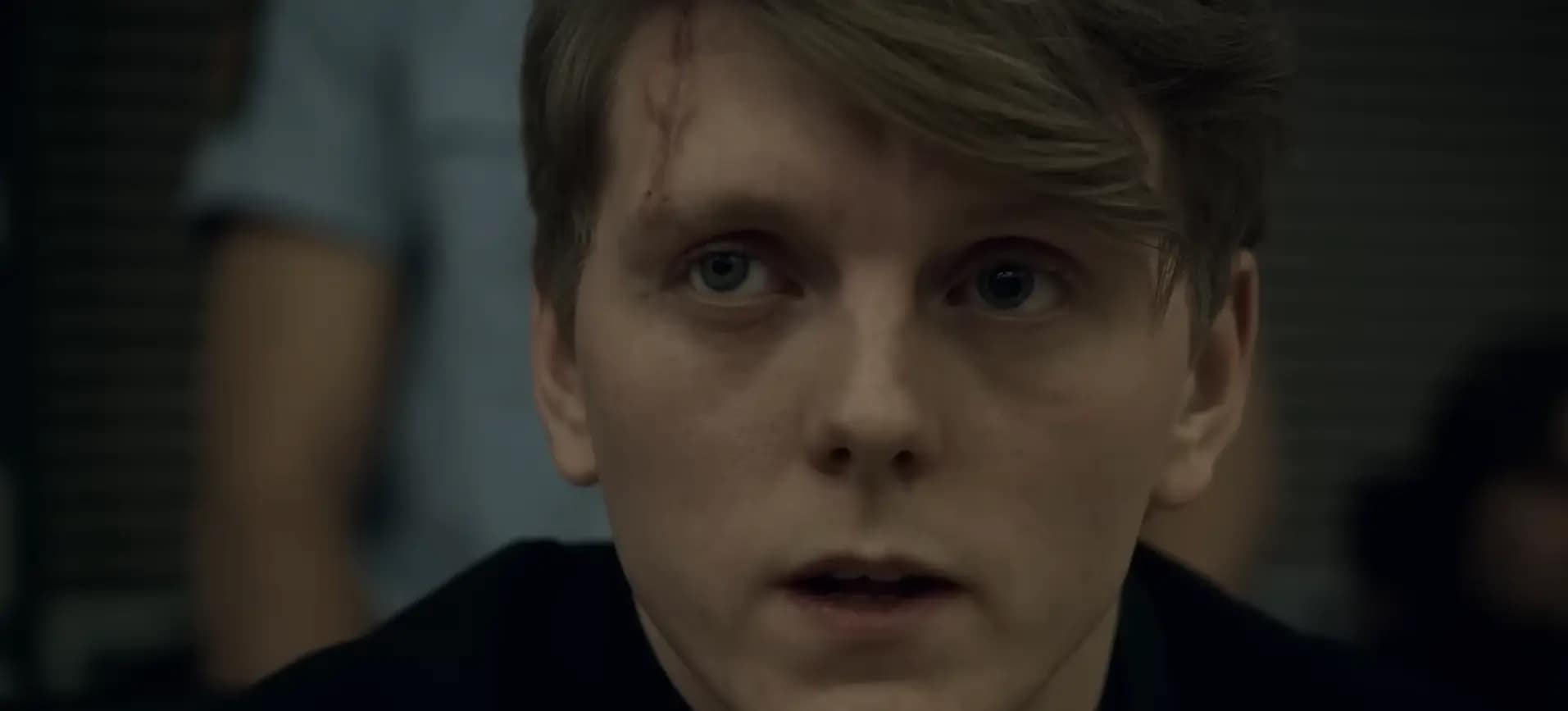
Released in 2018, Paul Greengrass’s “22 July” offers a brutal, uncomfortable look at the 2011 terrorist attacks in Norway. Starring Anders Danielsen Lie and Jonas Strand Gravli in the lead roles, the film’s greatest achievement is its absolute refusal to either sensationalize the violence or soften its blows for the audience’s comfort.
Instead, Greengrass forces you to sit in the uneasy world it creates, making you a witness to the horrific events it covers and the aftermath that follows. The characters feel incredibly real, stripped of any cinematic armor; you won’t find anyone magically becoming a superhuman here.
Where typical cinema often skips the agonizing middle path of trauma to jump straight to recovery, 22 July tracks every ugly, painful milestone of survival before any signs of recovery emerge.
22 July (2018) Plot Overview: Terrorism, Survival, and Recovery
The film initially follows Anders Behring Breivik (Anders Danielsen Lie), a right-wing extremist who causes an explosion at a government quarter in Oslo, Norway, resulting in multiple casualties. He then turns his deadly attention to the island of Utøya, where a group of teenagers are staying as part of the Workers’ Youth League (AUF) summer camp.
He deceives the organizers by saying he is a police officer who has been sent to secure the island following the attacks in Oslo. But the moment his identity is questioned, he shoots the organizers and ruthlessly opens fire on the trapped students. By the end, 77 people are dead. Among the few to survive his attack is a young student named Viljar Hanssen, who suffers life-threatening head injuries.
Following these violent events, the film begins to follow both the attacker and the victim. While Breivik is put under police custody, Viljar is rushed into emergency surgery. The rest of the movie explores Viljar’s painful physical and psychological trauma on his grueling path to recovery, while simultaneously diving into the legal proceedings and the dangerous ideologies behind the attacks.
22 July (2018) Visual Language: Making Audiences Feel Like Witnesses
I have seen various films within this genre, but I rarely feel as though I am standing right there alongside those characters. In “22 July”, I often felt like a witness to the events. There are distinct reasons the audience is pulled so deeply into this world: while the performances play a massive role, the film’s deliberate visual language is what solidifies the immersion.
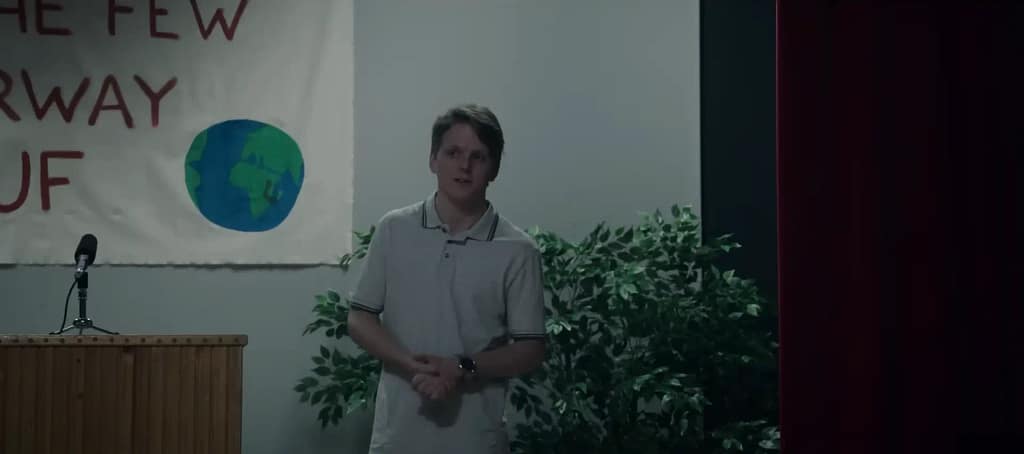
For starters, the film’s cinematography by Pål Ulvik Rokseth makes great use of Norway’s natural scenery, using muted, overcast tones that make the experience feel dark and lived-in. Next, the camera work is absolutely amazing. For instance, when Breivik begins shooting his targets, and Viljar is far away trying to make sense of the chaos, the camera shifts to a distinct perspective so audiences can understand his view.
Similarly, as the sequence progresses, the camera tracks Breivik from different angles, including chilling shots from the back. At key moments, the distinct shaky movements of the camera are intentionally preserved.
Due to these techniques, you feel as if you are either running with the camera to record the events or facing Breivik himself. The result is that you get a highly immersive experience that only amplifies the shock, hurt, and anger towards the horrible crimes committed on screen.
22 July (2018) Screenplay and Direction: Realism Over Extravagant Sensationalism
The film’s screenplay and direction are both helmed by Paul Greengrass. Although the movie is based on the non-fiction book, “One of Us: The Story of a Massacre in Norway – and Its Aftermath” by Åsne Seierstad, the screenplay is superb. It establishes the immense stakes from the early scenes themselves, where we see Breivik meticulously preparing for the assault.
The narrative spends a fair amount of time on Viljar before the tragedy, showcasing his kind, inclusive nature. When he bears the brunt of the violence, you feel devastated for him, yet Greengrass intentionally avoids dramatic music or overly emotional dialogue to milk the audience’s sympathy.
Conversely, Breivik is shown as a coldly calculated individual, and later, as a chillingly articulate speaker, even though his opinions are terrifying. However, immense care has been taken to ensure that he is never glamorized. The film brilliantly threads a fine line, presenting the reality of the events without turning the criminal into a cinematic icon.
Greengrass’s direction is equally stellar, maintaining a tight grip on your attention throughout. It’s clear that in this project, he is completely dedicated to delivering the most authentic presentation possible. Therefore, the film doesn’t shy away from either the scenes of gunshots or the raw visuals of brain surgery. While these scenes can make some viewers deeply uncomfortable, they reinforce the film’s honesty.
Another massive directorial achievement is the accurate portrayal of trauma in survivors. We often hear that the path to progress is never linear, but this one manages to show that. There are days when he is better and days when he isn’t, but the healing graph isn’t linear.
This is subtly captured in a scene where Viljar catches a glimpse of Breivik on the news, and his mind instantly drags him back to that horrifying day. That sequence quietly showed how trauma doesn’t just magically disappear when immediate danger disappears. Ultimately, Viljar’s final victory isn’t some grand physical blow to his attacker but rather discovering the will to face him in court and speak about his experiences. It is a quiet yet monumental climax that further cements the film’s unwavering commitment to realism.
22 July (2018) Acting Performances: Gravli Impresses while Danielsen Lie is Uniquely Exceptional
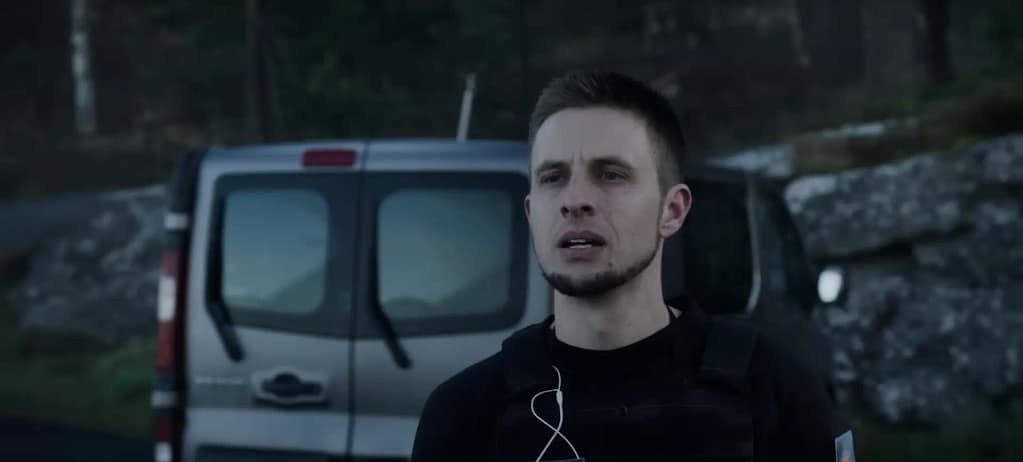
Even though he is playing a monster, Anders Danielsen Lie delivers an absolutely amazing performance. It stands as arguably one of the finest roles of his career, and that’s an incredibly high bar when you have several critically loved performances in your resume.
When you look back at his career, the performances that stand out the most are often “Reprise” (2006) and “Oslo, August 31st” (2011). Those films established him as a master of portraying driven, talented, quiet, yet emotionally broken characters. In “22 July”, however, he is in an entirely different space. His greatest impact is felt during the first thirty minutes of the runtime.
He plays a character who feels absolutely zero sympathy and is dead set on causing the maximum possible devastation. You could see the anger and hate in his eyes, and the ease with which he executes his mission just burns you from the inside. As a mature viewer, I can easily separate the actor from the performance.
Yet, I found myself hating him to the core and had to remind myself that it is merely a film. Just goes on to show that the level he is operating at, especially during the terrorist attack scenes, is absolutely insane.
On the other end of the emotional spectrum, Jonas Strand Gravli has done a marvelous job showcasing a wide range of emotions, including sacrifice, empathy, kindness, and anger. Unsurprisingly, my favorite scene of his is the courtroom climax. In that scene, he brilliantly captures the initial nervousness of facing his abuser, before gathering the courage to deliver a rock-solid statement.
Gravli’s performance didn’t surprise me one bit, as I first discovered his immense talent in Netflix’s “Ragnarok” (2020-23). So, I always knew how capable he was. However, a major revelation for me was Seda Witt (playing Lara Rashid), who makes a significant impact despite her limited screen time. Her courtroom testimony is a deeply heartfelt scene that stays with you long after she leaves the frame.
Final Verdict: Is 22 July (2018) Worth Watching?
22 July is absolutely worth watching, provided you know what you’re walking into. It’s a technically flawless, deeply necessary film that will leave an incredibly lasting impact. But it’s undeniably a challenging watch. There are multiple scenes that might make you uneasy or linger in your thoughts long after the credits roll.
This isn’t a passive piece of entertainment that you can randomly throw on in the background while tending to other tasks. “22 July” demands your undivided attention and a willingness to understand contrasting points of view. If you can commit to that, you will find yourself rewarded with a uniquely strong and unforgettable cinematic experience.
Leave a Reply