
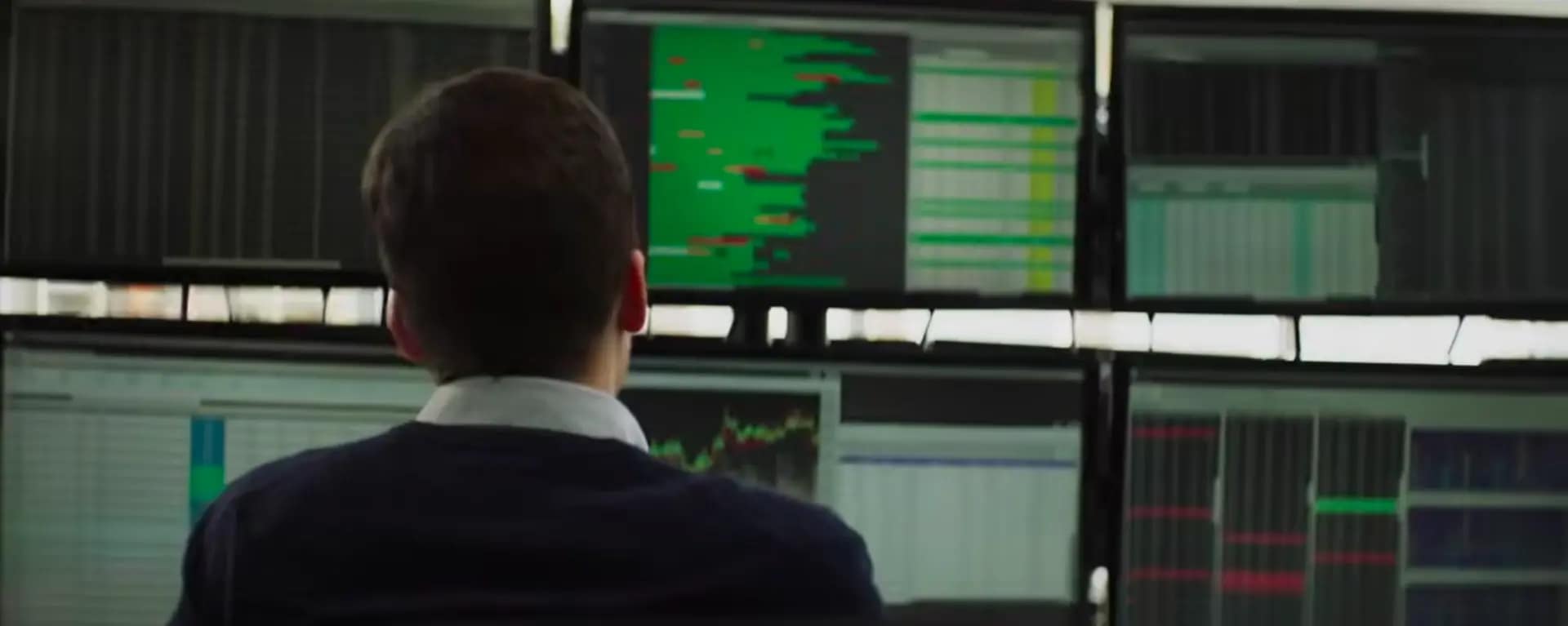
Starring Jesse Eisenberg and Alexander Skarsgård in the lead roles, Kim Nguyen’s directorial effort isn’t just another thriller drama about high-frequency trading. Neither is it simply another retelling of the David-Goliath Saga. The Hummingbird Project goes much beyond what either label suggests.
It offers a deep study of how far one’s obsession can take him, the effect it can have on others, and the industry he dreams of leading. But the film’s most heartfelt aspect is its focus on what that ruthless obsession costs the individual and the people close to him.
Reimagining the David-Goliath Saga in High-Frequency Trading
At its core, The Hummingbird Project is a story about two cousins, Vincent Zaleski (Jesse Eisenberg), a stockbroker, and Anton Zaleski (Alexander Skarsgård), a trading software programmer trying to build a straight fiber-optic cable from Kansas to New Jersey.
Their sole objective? Gaining a millisecond advantage in high-frequency trading. The Goliath in this story is their boss, Eve Torres (Salma Hayek), whose firm routes trade data between Kansas and New Jersey in 17 milliseconds. They eventually quit their jobs to work on their operations, and while they are initially looked at as David, the film makes you question that notion as well.
We eventually learn that while they are actively trying to bring down a major market player, they have financial backing from billionaire Bryan Taylor (Frank Schorpion), who owns another major firm.
To build this cable line, Vincent needs to drill beneath the properties that fall under their planned route. Vincent faces no problem getting permission from property owners, until he runs into an Amish farmer named Jonas Nieman (Johan Heidenbergh).
Vincent tells him that he would be paid handsomely, but Jonas flat-out refuses, explaining that he views his land as a gift meant for a simple life dedicated to God, not as a resource to be utilized for corporate wins.
The contrast between couldn’t be starker; one is focused on becoming the market leader, the other simply wants to continue his peaceful life of faith. Vincent is emotionally capable of understanding his decision, but instead of respecting it, Vincent gets what he wants by using financial and legal muscle.
To summarize, when Vincent meets a calm, harmless guy, he doesn’t behave like you expect him to. Instead, he unknowingly takes on the tendencies of the Goliath he desires to take down.
Through these moments, the film quietly asks if Vincent is deserving of your support even though he is the central character of the story. It also subtly demonstrates that the cost of taking down a Goliath is the erosion of morality. You become the very thing you hate.
Vincent’s Obsession: The Cost of Chasing Fame and Fortune
Throughout the film, we see Vincent remain obsessed with getting that one millisecond advantage in high-frequency trading, dragging Anton along in his wake. Both men pay for their grand ambition in different ways. In Anton’s case, he keeps coding in his hotel room to bring the time down to 16 seconds, which instead costs him precious time with his family.
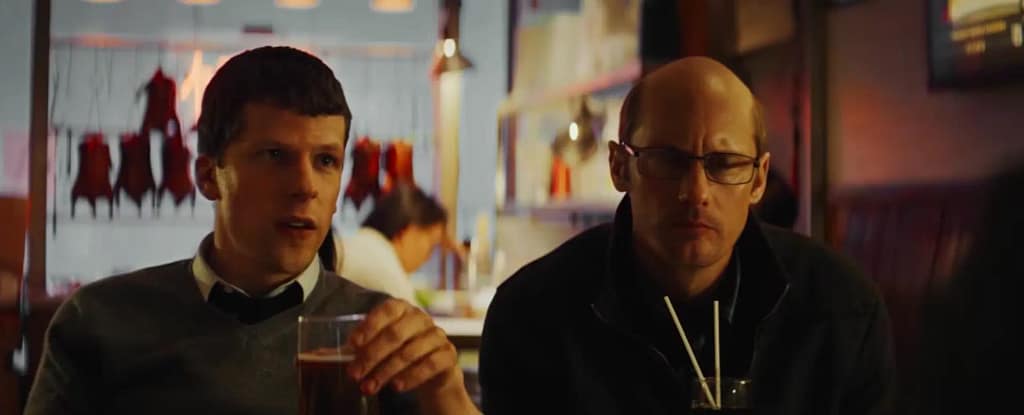
His family doesn’t get angry over his absence, although his wife does grow a little frustrated. Additionally, he gets arrested for Stock Market Fraud for utilizing proprietary code he wrote under Ever Torres. While he eventually gets his release, his problems paler in comparison to what Vincent encounters.
When Vincent learns he has stomach cancer and must begin treatment immediately, he rationalizes the cost of his health as if he’s looking at a financial statement.
He chooses to continue his work with the same intensity as before, because he is in the “middle of something important” and a lot of “people are dependent” on him. Vincent continues to work relentlessly for his mission even when his health gets visibly worse.
Even the sight of blood in his urine isn’t enough to stop him. When he discovers that Eve Torres has set up microwave towers, thereby retaining her market leader status, he marches towards her towers with a chainsaw in hand, in full maniacal fashion. Here’s a man literally pissing blood, aiming to destroy her property because he can’t accept not being at the top of the food chain.
His body ultimately collapses before he can get his revenge, and he has to be taken to the hospital urgently. Through Vincent, the film shows how much an individual will sacrifice his mental and physical health in pursuit of billions.
Selling the Vision: Dissecting the Direction and Cinematography
For the audience to feel what the film was trying to say, the execution had to be solid across the board. So, while the writing had done its part, it was up to other departments to deliver on the same level, which they absolutely did.
Cinematographer Nicolas Bolduc has utilized the overcast tones and crisp, sterile office visuals to capture the cold, calculative, and ruthless world of high-frequency trading.
Simultaneously, they have also captured the physical reality of fulfilling their dream. There are visuals of digging through swamps, rock, and thick forests that reflect the central characters’ internal struggle. They have essentially swapped one set of challenges for another, finding no relief in either.
Through visual styles, Nicolas Bolduc has quietly conveyed the internal state of the leads who feel challenged, frustrated, angry, and yet hopeful that it would all work out in the end.
A special mention must go to the makeup and styling department, which gave Vincent such an accurate look for a person suffering from stomach cancer, that I felt that maybe Jesse Eisenberg went through extreme weight loss for those sequences. In reality, that striking transformation was achieved through the skills and efforts of the aforementioned teams.
As for Kim Nguyen’s direction, it is impressive, but the film could have been a little better if certain scenes were allowed more room to build tension. For instance, when Vincent suffers from agonizing stomach pain on a flight, the film moves on from that scene a little too quickly.
Apart from that, the film’s climax felt a little flat and could have benefited from a more emotionally charged sequence centered on Vincent’s deteriorating health.
The Hummingbird Project Acting Performances: Solid Work All Around

Visually, Alexander Skarsgård was the most impressive, who dropped his leading man aesthetic to fit the character of a haunchy, socially awkward programmer. He behaved like someone who was always lost in his thoughts, which is precisely what the character demanded of him. Even his victory dance has a restrained energy to it, typical of an introverted genius.
Michael Mando delivers a grounded performance as a construction project manager, Mark Vega. His best moments occur during a heated confrontation with a landowner over ethnic discrimination and a later scene where he walks alongside Vincent’s stretcher as he’s being moved into the hospital. Mando captures both the quiet frustration of discrimination and genuine concern for a friend really well.
I think with his success playing or voicing negative roles, The Hummingbird Project is a great reminder that he’s a good actor, in general, not just a good villain.
Speaking of villains, Salma Hayek did well with what she was given. Her best moment comes while convincing Anton to not quit by admitting she hired Vincent so that he could “have a pet”. This entire exchange captured the arrogance of her character, which was portrayed by her appropriately.
The star of the show is, unsurprisingly, Jesse Eisenberg. Whether it’s Batman Vs Superman (2016), The Social Network (2010), or Now You See Me (2013), he is a master at playing these hyper-smart, driven, and obsessed characters.
His performance in this film is just as good. A lesser-capable actor would have tried to soften the character’s darker shades like arrogance and entitlement. Not Jesse Eisenberg, though.
He is totally committed in every scene, be it the depiction of powering through piercing stomach pain or getting his operations insured even while strapped to a stretcher; the guy is in top form throughout. Eisenberg’s most impactful scene features him drenched in sweat in a grey suit, mumbling to himself that he’s going to destroy Eve’s towers all while his body is actively failing.
If there ever was one scene that best encapsulates what it looks like to be completely possessed by corporate greed and ambition, it’s this one. This scene lives rent-free in my head, and I don’t think it’s going anywhere. When it’s all said and done, I genuinely believe Jesse Eisenberg’s performance in this film would be considered among his most underrated performances of all time.
Final Verdict: Is The Hummingbird Project (2018) Worth Watching?
The Hummingbird Project isn’t a perfect film. The emotional scenes get cut off a little too soon, and the ending feels a little flat. But, in my view, it’s not just worth watching, it’s also a deeply necessary film for everyone. I look at this film as a necessary reminder of what’s important in life beside ambition: connection and health.
All of us are trying to accomplish something in our lives. I believe there’s a Vincent in each of us. It’s up to us to find the right balance between ambition, peace, and connection, because every one of them matters.
Leave a Reply